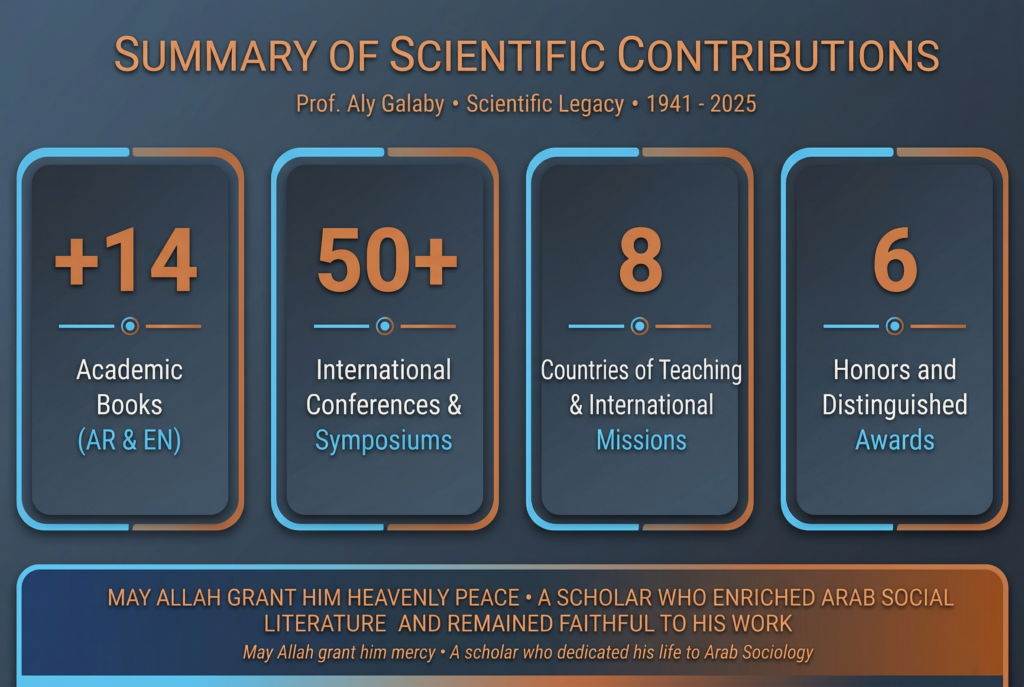
Academic Legacy & Bibliography: Prof. Dr. Aly Abdel Razek Galaby
Aly Abdel Razek Galaby was born on 14/8/1941 in Egypt and works as a Professor of Sociology Faculty of Arts at Alexandria University and he got a Master’s degree in 1970 and a Ph.D. in 1973 from Alexandria University. He worked as an expert at the National Centre for Social Research and Crime Cairo in 1973 and the head of the Department of Sociology Alexandria 1990, Faculty of Social Sciences Qatar 1997. He also acted as an advisor to the National Centre for Research 2008 and decision of the Standing Committee promotions Supreme Council for Universities 2013 and 2016 and travelled on a scientific mission to the United States and Austria 1974 and seconded to work in a number of universities Arabic Beirut King Abdulaziz Qatar al-Jazair United Arab Emirates. He got the scientific promotion 1982 and Excellence 2004 membership of the Association Egyptian and Arab for sociology. He participated in conferences and seminars for children’s work UNESCO and the National Research Centre, 1992 and organized crime in the Arab nation Riyadh 1998 and social capital in Egypt Bibliotheca Alexandrina 2003 Social Responsibility and Citizenship 2009 National Centre for Research on the dialectic of social integration and nation-building in the Arab nation Qatar 2013 information systems in our life Alexandria 2016. His research has been presented at conferences on social inclusion and active citizenship Qatar 2013 Quality Assurance at universities Arabic Sharjah 2014 Egyptian knowledge Circles Alexandria 2016 and research published in scientific journals based on Knowledge Development Institute National Planning 2013 Globalization and the Identity Crisis Journal of the Arabic sociology 2017 and contributed to the authoring and translation of several books and number of research projects, the evaluation of scientific production and the validity of articles submitted for publication in a number of scientific journals.
The Journey
The scholarly work of Professor Ali Abdul Razek Jalabi represents a cornerstone in modern Arabic sociology. His intellectual journey spanned over five decades, during which he meticulously updated and refined his theories to keep pace with global sociological transformations. His publications are categorized into three pivotal eras:
1. The Foundational Era (1970s – 1980s)
Focus: Sociological Foundations, Demographics, and Organizational Structures.
- Sociology of Population (1977): One of his most renowned works, establishing the fundamental basis for studying population as a social phenomenon.
- Sociology of Organization (1982): A deep dive into bureaucracy, institutional frameworks, and social systems.
- Social Change (1985): An analytical exploration of transformation theories in both traditional and modern societies.
- Studies in Labor Force (1988): A focus on the sociological aspects of labor, production, and the workforce.
2. Methodological Maturity (1990s)
Focus: Rooting Scientific Research Tools and Methodologies.
- Social Research Design: Foundations and Strategies (1992): A seminal reference for sociology students and researchers worldwide.
- Quantitative Methods in Sociology (1994): Focused on social statistics and mathematical applications in social research.
- Qualitative Methods in Sociology (1995): An essential guide to interviews, observation, and understanding social meanings.
- Industrial Sociology (1997): A comprehensive analysis of industrial institutions and labor relations.
3. Globalization & Contemporary Theory (21st Century)
Focus: Modern Thought, Globalization, and Post-Modernity.
- Introduction to Sociology (2000): A comprehensive volume bridging the gap between classical theory and modern application.
- Urbanization and City Life (2005): A critical study of urban growth and the challenges of modern city living.
- Contemporary Sociological Theory (2010): An extensive review of the theories that emerged in the late 20th century and beyond.
- Globalization and Everyday Life (2012): One of his most vital modern works, linking macro-globalization with the micro-details of daily existence.
- Post-Modernism and Society (2015): A profound analysis of contemporary cultural and intellectual shifts.